The mechanics of options trading
How an options trade actually works — buyers, sellers, the clearinghouse, and where you trade.
How options trading works
Options trading means buying or selling contracts that give the buyer certain rights over an underlying asset, like a stock or index. Trades take place on regulated, centralized exchanges, which keeps contracts standardized and transparent.
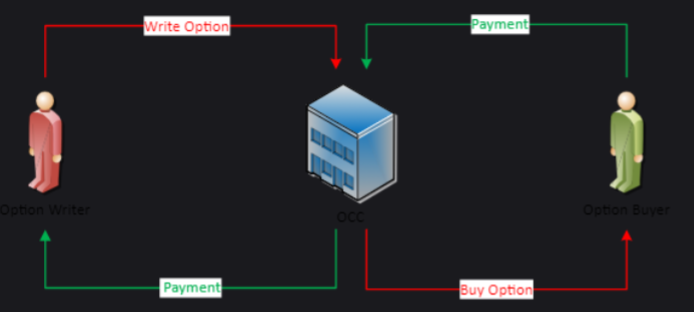
Every trade has two sides:
- The buyer (holder) pays a premium for the right to buy (call) or sell (put) the underlying — and is never obligated to exercise.
- The seller (writer) collects the premium and must fulfill the contract if the buyer exercises.
If you buy options (holder)
Buyers pay the premium and risk only that premium. Their upside depends on direction:
- Call buyer — pays a premium for the right to buy at the strike. Profit potential is theoretically unlimited as the price rises; risk is capped at the premium paid.
- Put buyer — pays a premium for the right to sell at the strike. Profits as the price falls below the strike; risk is capped at the premium paid.
If you write (sell) options
Writers collect the premium up front, but take on the obligation — and far larger risk:
- Call writer — collects the premium and must sell at the strike if exercised. Max profit is the premium; risk is unlimited if the price rises sharply.
- Put writer — collects the premium and must buy at the strike if exercised. Max profit is the premium; risk is substantial if the price drops sharply.
Where you trade options
Options trade in two main places:
- Centralized exchanges — e.g. the CBOE or the Nasdaq Options Market. Regulated, with standardized contract terms (size, expirations).
- Brokerage platforms — e.g. Interactive Brokers, thinkorswim, Robinhood, E*TRADE. Friendlier front-ends with analysis tools and real-time data.
What a platform shows you
Most options platforms give you:
- Options chains — every available contract for an asset, with its strikes, expirations and premiums.
- Risk tools — profit/loss calculators, margin requirements, exposure.
- Order types — market and limit orders, plus advanced strategies like spreads and iron condors.
A basic trade, end to end
Say you think stock ABC (trading at $50) will climb to $60 within a month.
You buy a call with a $55 strike, expiring in a month, for a $2 premium.
If ABC rises to $65 before expiration, you buy at $55 and sell at $65 — an $8 profit ($10 gain minus the $2 premium).
If ABC never gets above $55, the option expires worthless and your loss is capped at the $2 premium.
Final thoughts
Options give you flexibility and real profit potential, but the roles matter: buyers risk a known premium, while writers take on much larger obligations. A reliable platform with solid risk tools makes the difference.
Next up: how options are priced, and the forces that move that price.
Educational content — not financial advice.